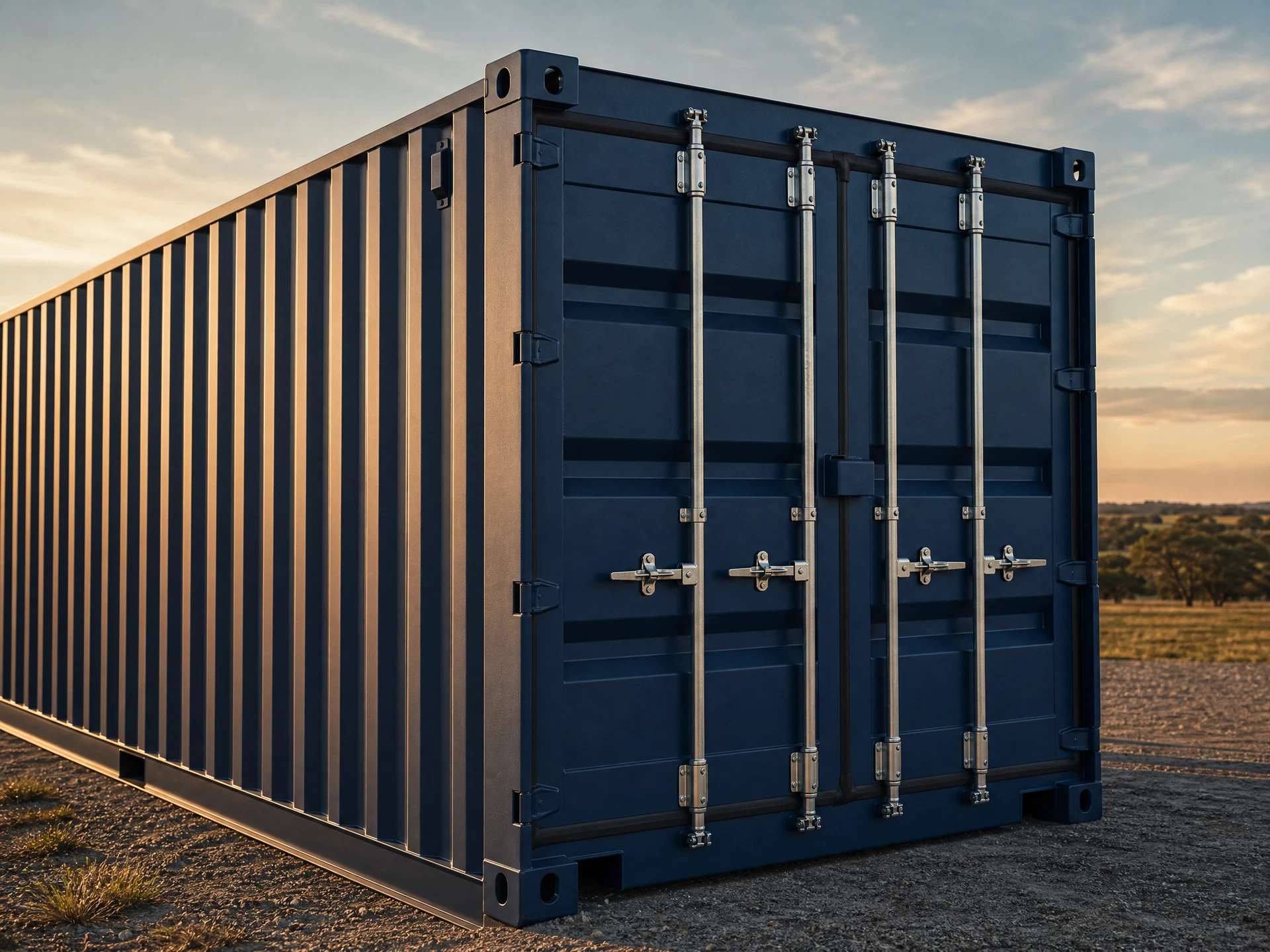
20' Standard
20' × 8' × 8'6"
Common 20-foot exterior envelope
New One Trip, Cargo Worthy & Wind & Water Tight — pay on delivery — no hidden fees

Container specifications
Compare all eight configurations using published carrier and supplier reference specifications. Exact interior measurements and weight ratings still depend on the individual unit.
8
Offered configurations
4
Nominal exterior envelopes
1
Exact CSC plate to verify
Planning reference—not a unit guarantee
Carrier and supplier guides state that interior dimensions, door openings, tare weight, payload, and capacity can vary by manufacturer, series, age, materials, and owner. Use the container's CSC/data plate for its weight ratings and measure the actual unit when an inch matters. Sources [1] [2] [5]
Standard, double-door, and side-open features can share the same nominal outside length, width, and height. The doors and reinforcement are what change access, interior clearance, and weight.
20' × 8' × 8'6"
Common 20-foot exterior envelope
20' × 8' × 9'6"
One additional foot of exterior height
40' × 8' × 8'6"
Common 40-foot exterior envelope
40' × 8' × 9'6"
One additional foot of exterior height
Values marked “about,” “model example,” or “examples” are intentionally not presented as guaranteed inventory measurements.
20ST · End doors
Often chosen for
General storage, tools, household goods, and sites needing the shorter footprint.
Exact-unit note: Representative Hapag-Lloyd fleet example; ONE publishes closely aligned dimensions with a lighter tare example.
20HC · End doors
Often chosen for
Tall equipment or stacked storage when a 20-foot footprint is preferred.
Exact-unit note: 20-foot high-cube units are less standardized across fleets; confirm the exact door height and CSC plate.
40ST · End doors
Often chosen for
High-volume storage where standard 8-foot-6-inch exterior height is preferred.
Exact-unit note: Representative Hapag-Lloyd fleet example; carrier fleets and manufacturing series vary.
40HC · End doors
Often chosen for
Maximum common dry-container storage volume and taller loading clearance.
Exact-unit note: Representative Hapag-Lloyd fleet example; ONE publishes similar dimensions with another tare/payload combination.
20DD · Double end doors
Often chosen for
First-in/first-out access, long materials, or dividing one container into two accessible zones.
Exact-unit note: The second door assembly can change interior length, tare, and clear openings. Verify the exact build.
40HCDD · Double end doors
Often chosen for
Large storage layouts needing access from either end plus high-cube height.
Exact-unit note: Published tunnel-container ratings vary by builder; the inventory unit's CSC plate controls.
20FSA · Full side access
Often chosen for
Forklift, pallet, bulky-item, retail, event, or conversion access from the long side.
Exact-unit note: Side-door count, reinforcement, opening size, and weight ratings differ materially by manufacturer.
40HCFSA · Full side access
Often chosen for
High-volume storage or conversions needing broad side access and extra interior height.
Exact-unit note: Reinforcement and door hardware materially affect interior clearance and weight ratings; verify the exact unit.
Simple access
A practical fit for general storage when cargo can be loaded and reached from one end.
+1 foot outside
Adds a foot of exterior height and roughly a foot of interior height for taller items or stacking.
Both ends open
Useful for long materials, first-in/first-out access, or two separately accessible storage zones.
Broad side access
Bi-fold side doors improve forklift, pallet, bulky-item, retail, and conversion access.
New One Trip, Cargo Worthy, and Wind & Water Tight units generally keep their nominal exterior envelope. Condition affects wear, repairs, certification, door operation, and the need to inspect the exact container; it does not turn a standard-height unit into a High Cube.
Choose a reasonably level, firm placement area and discuss supports appropriate for the site.
Check before delivery
Consider gate width, turns, soft ground, fences, trees, buildings, and room for the truck and trailer.
Check before delivery
Look for power lines, branches, roof overhangs, and other obstructions along the full delivery route.
Check before delivery
Send photos or video of the route and placement area when requesting a quote so the team can discuss a practical delivery plan.
These links support the representative values and variation notes above. They describe carrier-fleet or supplier-model examples, not guaranteed measurements for a Connex Cowboys inventory unit.